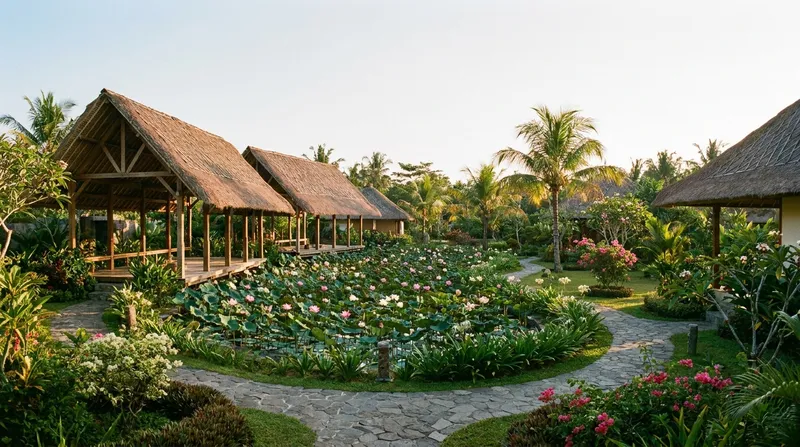
Short answer: for recovery, the postcode matters less than three things — distance from your triggers, reasonable access to a hospital, and a calm setting. The quiet interior around Ubud, rural Tabanan and calmer southern areas such as Sanur usually do better on those than the nightlife districts of Canggu, Seminyak and Kuta. The comparison below explains the trade-offs; if you are comparing treatment itself rather than places, see our drug rehab in Bali and alcohol rehab in Bali programs or the rehab centre in Bali overview.
Which area of Bali is best for rehab?
| Area | Setting | Triggers and noise | Hospitals and airport |
|---|
| Ubud | Green interior, rice fields, river valleys | Quiet outside the busy town centre | Local clinics; main hospitals in the south, airport typically 60–90 min |
| Tabanan | Rural regency, farmland, black-sand coast | Very quiet, few nightlife triggers | Regional hospital in Tabanan town; airport typically 60–90 min |
| Sanur | Calm east-coast beach town | Low-key, little late nightlife | Close to Denpasar hospitals; airport about 30 min |
| Uluwatu / Bukit | Clifftop villas, limestone peninsula | Quiet in places, but beach clubs nearby | Hospitals in Nusa Dua and the south; airport typically 30–45 min |
| Canggu | Surf-and-café belt, fast-growing | Strong party culture and traffic | Clinics nearby; airport typically 45–90 min in traffic |
| Seminyak / Kuta | Resort and nightlife strip | Highest availability of alcohol and drugs | Close to hospitals and the airport |
Travel times are typical and depend heavily on traffic. Whatever the area, ask any centre you are considering how far it is from the nearest hospital emergency department and how a medical transfer would work.
When someone decides to treat an addiction far from home, the question is rarely just "which clinic." It is also "which place" — because the environment a person recovers in shapes how the work feels, how protected they are from old triggers, and how willing they are to actually stay the course. Over the years we have watched the island setting do quiet, real work in people's recovery: not as a holiday backdrop, but as a genuine therapeutic asset. This guide explains why Bali has become a serious destination for residential addiction treatment, what the setting offers clinically, and the practical things worth weighing before you travel.
Why Bali works as a destination for recovery
The strongest argument for treatment in Bali is distance — not from accountability, but from the daily architecture of the addiction. At home, the route to the off-licence, the dealer's number, the bar where everyone knows you, and the social circle built around using are all within arm's reach. Geography alone removes a large part of that pull. A guest who flies in from London, Sydney, Singapore or Jakarta arrives somewhere their habitual cues simply do not exist, which buys the early, fragile weeks a kind of breathing room that is very hard to engineer back home. Combined with a structured residential program, that clean break is one of the most underrated advantages of treating addiction abroad.
Privacy and discretion, properly understood
For many people — executives, public figures, professionals whose careers depend on reputation — the fear of being seen walking into a local rehab is a real barrier to getting help at all. Bali offers genuine discretion. Travelling here reads, to almost everyone, as an ordinary trip; nobody at the office or in the family WhatsApp group needs to know more than that. Inside a reputable facility, confidentiality is treated as a clinical obligation, not a marketing line. We never confirm or discuss who is in our care with anyone the guest has not authorised. That privacy is not about hiding the work of recovery — it is about removing the social cost that stops people from starting it.
Climate and environment as part of the treatment
There is solid clinical sense behind the tropical setting. Early recovery is physically depleting: sleep is disrupted, appetite is unreliable, and the nervous system is recalibrating. A warm, stable climate makes gentle daily movement — walking, swimming, yoga — feel possible rather than punishing, and consistent activity is one of the better-evidenced supports for mood and sleep in early sobriety. Natural light and time outdoors help reset circadian rhythms thrown off by years of using. Our holistic recovery work leans deliberately on this: breath practice in the morning air, time in the garden, meals made from fresh local produce. None of it replaces the clinical core, but it makes the clinical core easier to do.
The recovery environment: calm, contained, supported
Beyond climate, what matters is the felt quality of the place. A good recovery setting is calm and contained — quiet enough for reflection, structured enough to hold someone who is wobbling, and beautiful enough that staying does not feel like a punishment. Bali's culture has a gentleness to it that guests often comment on; the unhurried pace and the warmth of local staff create an atmosphere that lowers defences and makes honest therapeutic work more possible. Inside that container, the real engine of recovery runs: individual therapy, group sessions, and a daily rhythm that slowly rebuilds the capacity to live without a substance.
Accessibility: getting here from anywhere
Practically, Bali is well connected. Ngurah Rai International Airport (Denpasar) receives direct flights from across Asia, Australia and the Middle East, with onward connections from Europe and the Americas, so reaching the island is rarely the obstacle people imagine. Once here, the main residential and lifestyle districts are reasonably close together. Many guests are already familiar with the island from previous trips, which removes the disorientation of arriving somewhere entirely foreign while in crisis. For families coordinating an admission, that combination of good flight access and a familiar destination makes the logistics of getting a loved one into treatment far less daunting; our team walks every family through it during admissions.
How the island's areas relate to a treatment stay
Guests come to us from every corner of Bali and arrive through every kind of trip. Some were living or working in the surf-and-cafe belt of Canggu, where the expat party culture is precisely what tipped social drinking into a problem. Others come from the polished bars and nightlife of Seminyak, or from the resort strip of Kuta and Legian, where availability and a permanent-holiday mindset make moderation hard to hold. We see professionals and families from Denpasar and quieter Sanur, wellness-minded guests passing through Ubud in the island's green interior, and people staying among the clifftop villas of Uluwatu on the Bukit peninsula. Wherever someone is travelling from, the point of residential treatment is the same: a deliberate step out of that everyday environment and into a contained, supported one. We mention these areas only as context — the facility itself is a single, private location.
Family visits and staying connected
Recovery is rarely a solo project, and the island setting handles family involvement well. Bali is an easy and welcoming place for a partner or parent to fly into for a structured family session or a supervised visit, and the abundance of comfortable, discreet accommodation nearby means loved ones can stay close without intruding on the clinical environment. We coordinate visits carefully — timing them to the stage of treatment, because too much contact too early can pull focus, while well-placed family work later can be transformative. For relatives who cannot travel, structured video sessions keep them part of the process, and our aftercare support deliberately includes the family system in planning for the return home.
What to look for in a rehab location
Not every "rehab in paradise" is what it claims to be, and the setting should never distract from the substance of the care. When you assess a location, look past the photography and ask concrete questions:
- Is it a genuine clinical facility, or a wellness retreat in disguise? A real program is built around qualified clinical staff and structured therapy, not just nice surroundings.
- Is it contained and private? A recovery setting should be quiet, secure, and free of the nightlife and availability that fuelled the problem — not in the middle of a party district.
- How is medical risk handled? Withdrawal from alcohol or some drugs can be dangerous; the location must have proper detox support and a clear plan for medical escalation.
- Is access realistic for you and your family? Consider flight connections, the distance from the airport, and whether loved ones can visit.
- Does the environment support the whole day? Look for space for movement, rest, reflection and group life — the things that fill the hours between therapy sessions.
Get those answers and the "location" question resolves itself: the right place is the one where serious clinical care and a genuinely restorative environment sit together.
A setting, not a cure
It is worth saying plainly: Bali does not cure anyone. No location does. What a good setting does is remove obstacles and add support — it takes away the triggers and the shame that keep people stuck, and it adds calm, structure, light and human warmth that make the hard internal work more doable. The recovery itself still comes from the therapy, the honesty, the relationships and the plan for life afterwards. If you are weighing whether to travel for treatment, that is the right frame: not "will Bali fix this," but "will recovering here give me the best possible conditions to do the work." For many people, the answer is yes.
If you are considering treatment for yourself or someone you love, the next steps are simple. Read about our programs to understand what residential care actually involves, see what the first week is really like, and reach out to our team confidentially whenever you are ready. We will answer your questions honestly — including whether travelling here is the right move for your situation at all.